Postdevelopmental Approaches to Childhood Art by Jayne Osgood Mona Sakr
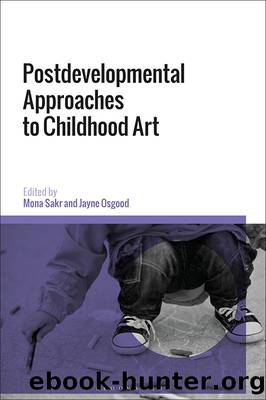
Author:Jayne Osgood, Mona Sakr [Jayne Osgood, Mona Sakr]
Language: eng
Format: epub
ISBN: 9781350183315
Barnesnoble:
Publisher: Bloomsbury Academic
Published: 2020-09-17T00:00:00+00:00
6
âYou Canât Separate It from Anythingâ: Glitterâs Doings as Materialized Figurations of Childhood (and) Art
Jayne Osgood
What happens when art and early childhood are viewed beyond concerns for human development? This chapter troubles the hegemony of developmentalist logic that shapes early childhood curriculum and pedagogical practices with the intention of highlighting the limiting effects of a narrow concern with representationalism, linear progress and human exceptionalism. I argue that breaking free from developmentalism opens up possibilities within early childhood for adults to be open to the (k)not-known and not-yet-known about childhood entanglements with art. By pursuing diffractive lines of enquiry, the chapter explores some ruptures that allow ideas about children, materials and art to be rethought. The discussion is framed by feminist new materialist philosophies and concepts offered by Jane Bennet (thing power, ecologies), Kathleen Stewart (ordinary affects), Erin Manning (the minor gesture), Nancy Tuana (viscous porosity, interactionism) and Harawayâs SF philosophy, which together provide the conceptual and practical means to rematerialize the social and take seriously the agency of the natural. With glitter as materialized figuration (Haraway, 1994, 1988, 1989), the framework allows for the articulation of alternative stories about what gets produced within, with and from childhood art materials. Specifically, working with glitter allows for tracing, reconfiguring and generating debates about childhood that bring concerns with contemporary art, gender, capitalism, the environment and activism into the fray. I conclude by arguing that there is much to be gained by reaching beyond registering glitter as something superficial, frivolous, habitual, ubiquitous, gaudy and messy; when taken seriously glitter can underscore the importance of an entangled sensibility that demands a heightened ethics of responsibility in our research, pedagogical and world-making practices.
The stories currently told about children, materials and artistic practices in early childhood contexts
As the collection of chapters in this book attests, within the field of early childhood education, a near obsessive preoccupation for standardized development of the child reigns supreme. Children are expected to move through predictable, identifiable and recognized stages of development, and the primary task for the early childhood educator is to support children to progress from one stage of development to the next. Engaging children in the production of artwork begins from a very young age and persists throughout early childhood as an important means to both support and measure this much coveted development. âMessyâ, multisensory exploration through artistic activities is viewed a crucial part of the early years curriculum. Within developmentalist logic, it is thought possible to know what children are demonstrating when they are engaged in artistic activities; for developmentalists, discerning precisely what childrenâs artistic expression represents holds the key to knowledge about childrenâs cognitive, physical, social and emotional development. As early childhood becomes ever more regulated and tightly shaped by policy imperatives to prove national competitive standards (as evidenced by the recent introduction of âBaby PISAâ testing by the OECD), the concern to know, measure and fix children at ever younger ages comes to dominate pedagogical and parenting practices. Adults are persistently concerned with what children
Download
This site does not store any files on its server. We only index and link to content provided by other sites. Please contact the content providers to delete copyright contents if any and email us, we'll remove relevant links or contents immediately.
The Art of Coaching Workbook by Elena Aguilar(51222)
Trainspotting by Irvine Welsh(21690)
Twilight of the Idols With the Antichrist and Ecce Homo by Friedrich Nietzsche(18642)
Fangirl by Rainbow Rowell(9262)
Periodization Training for Sports by Tudor Bompa(8278)
Change Your Questions, Change Your Life by Marilee Adams(7788)
This Is How You Lose Her by Junot Diaz(6894)
Asking the Right Questions: A Guide to Critical Thinking by M. Neil Browne & Stuart M. Keeley(5779)
Grit by Angela Duckworth(5623)
Red Sparrow by Jason Matthews(5479)
Paper Towns by Green John(5196)
Room 212 by Kate Stewart(5130)
Ken Follett - World without end by Ken Follett(4740)
Housekeeping by Marilynne Robinson(4456)
The Sports Rules Book by Human Kinetics(4398)
Papillon (English) by Henri Charrière(4278)
Double Down (Diary of a Wimpy Kid Book 11) by Jeff Kinney(4278)
The Motorcycle Diaries by Ernesto Che Guevara(4106)
Exercise Technique Manual for Resistance Training by National Strength & Conditioning Association(4076)
